"Our customers are small and medium businesses." Half of all ideal customer profiles start this way, and you cannot find a single company with it. An ICP (ideal customer profile) is useful only when a stranger can take a list of companies and say "fits" or "does not fit" about each one by looking at its website.
Below is what such a profile is made of, how to test it, and how to draft the first one from your own site.
What a working profile contains
- Segment. A short name and one sentence about who they are. "Regional residential developers" instead of a general "real estate".
- Industries, geography, size. Three filters that cut away most of the market at once.
- Signs on the website. Words and technologies that give a fitting company away from the outside: "sales team", "HubSpot", "wholesale customers".
- Who fits. Three to five checkable statements about the company. Each one has to be visible on the site, in job postings or in the news.
- Who we skip. Two to four disqualifiers that rule a company out even when everything else matches.
- When to write. Events after which the product is needed right now: hiring, a launch, a tender, a new head of a department.
- Cases. Results you already got with such customers. Without them an email promises; with them it shows.
Example: a CRM integrator
A company that sets up CRM and telephony could have a profile like this.
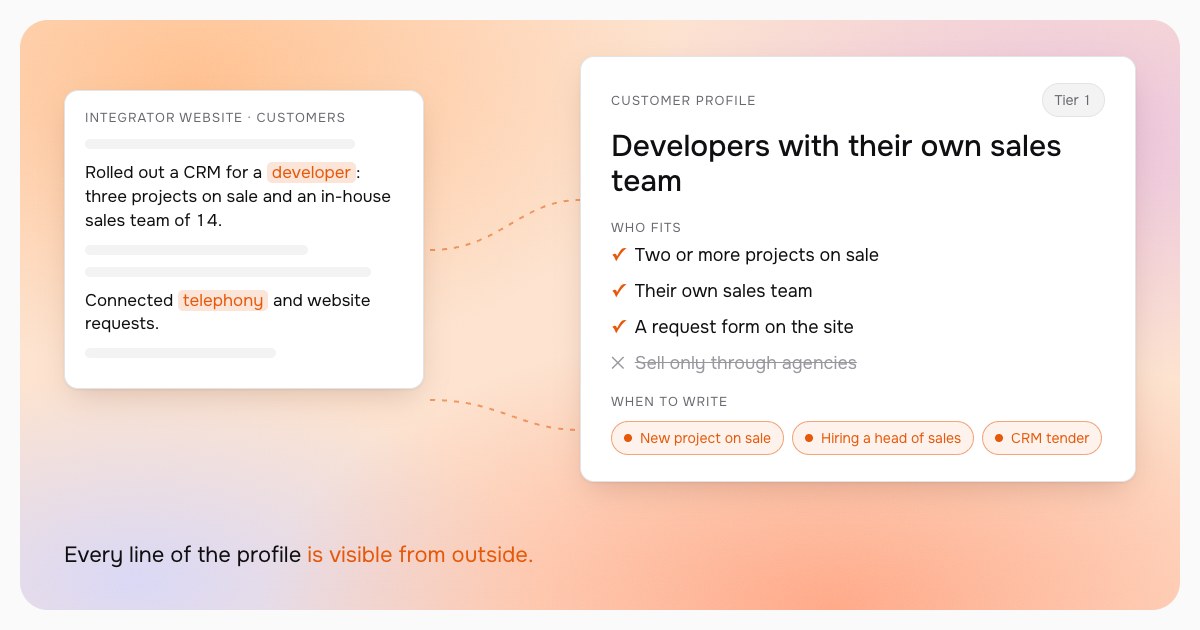
Segment: residential developers that sell apartments through their own sales team.
Signs on the website: several residential projects on sale, a request form, a sales phone line, open roles for sales managers.
Who fits:
- two or more residential projects on sale;
- the company has its own sales team, agencies help at most;
- the site has a request form or online booking for viewings.
Who we skip: commercial property only; sales fully handed over to agencies.
When to write: sales start for a new project; an opening for a head of sales; a tender for CRM or telephony.
With a profile like this you can open any developer site and know within a minute whether to write. You can also hand it to software: each statement is checked against the text of the pages.
You need several profiles
One profile for the whole market always comes out vague. Three or four narrow ones with a priority work better: first the one where you are strongest and have the clearest cases, then two or three to grow into. Emails differ by profile as well: a developer and a distributor need the same CRM for different reasons.
How to test a profile
Take twenty companies you would love to win and twenty random ones from the same industry. Go through each with the profile in hand.
- If half of the statements cannot be answered from the website, they are too internal. "Has a budget for implementation" is invisible from the outside; "is hiring sales managers" is visible.
- If random companies pass as easily as the ones you want, the profile is too broad: add disqualifiers.
- If the companies you want are rejected, the profile describes a dream that the market does not match.
Common mistakes
- "Everyone who needs our product." That describes the product; you cannot find a customer with it.
- Signs nobody can see from the outside. Pain, budget and process maturity come up on a call; you cannot search by them.
- Triggers that are never published. "Unhappy with the current vendor" shows up neither in the news nor in job postings.
- A profile written once and for all. After the first twenty conversations it is worth rewriting around who actually replied.
Drafting the first profile in five minutes
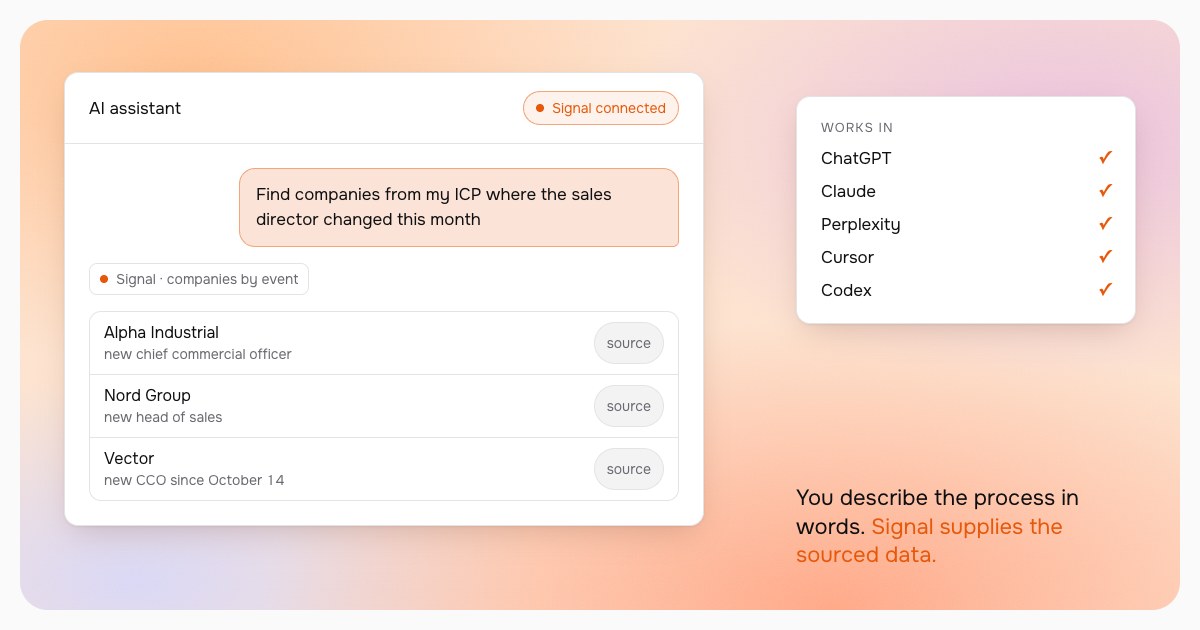
The fastest draft comes from your own website: it already says what you sell, to whom and with what results. In Signal it is enough to paste a link to your site, a document or a file: it reads your product, customer and pricing pages and suggests several segments, each with its signs, disqualifiers and events. You edit the draft right in the table and turn the events of a profile into signals that look for companies where the event happened.